In today’s digital economy, data has become one of the most valuable assets for businesses and organizations. From small startups to global enterprises, the ability to collect, analyze, and interpret data plays a critical role in decision-making and innovation. Two terms that are often used interchangeably—but are actually quite different—are Data Analytics and Data Science.
If you’ve ever wondered whether these fields are the same, or which one is better for your career or business needs, you’re not alone. While both disciplines revolve around data, they differ significantly in terms of scope, techniques, tools, and outcomes.
In this comprehensive guide, we will break down the differences between Data Analytics and Data Science, explore their similarities, and help you understand which path might be right for you.
What Is Data Analytics?
Data Analytics refers to the process of examining datasets to draw conclusions about the information they contain. It focuses on analyzing historical data to identify patterns, trends, and insights that can inform business decisions.
Key Objectives of Data Analytics
- Understand past performance
- Identify trends and patterns
- Support decision-making
- Optimize processes
Types of Data Analytics
- Descriptive Analytics
Answers the question: What happened?
Example: Monthly sales reports. - Diagnostic Analytics
Answers: Why did it happen?
Example: Analyzing why sales dropped in a specific region. - Predictive Analytics
Answers: What is likely to happen?
Example: Forecasting future demand. - Prescriptive Analytics
Answers: What should we do?
Example: Recommending optimal pricing strategies.
Tools Commonly Used in Data Analytics
- Excel
- SQL
- Tableau
- Power BI
- Python (basic usage)
Skills Required for Data Analytics
- Data visualization
- Statistical analysis
- Business understanding
- Querying databases
- Communication skills
What Is Data Science?
Data Science is a broader and more complex field that combines statistics, programming, machine learning, and domain expertise to extract knowledge and insights from structured and unstructured data.
Unlike Data Analytics, Data Science not only analyzes past data but also builds models to predict future outcomes and automate decision-making processes.
Key Objectives of Data Science
- Build predictive models
- Discover hidden patterns
- Automate decision-making
- Create data-driven products
Core Components of Data Science
- Data Collection & Cleaning
Gathering raw data and preparing it for analysis. - Exploratory Data Analysis (EDA)
Understanding data characteristics through visualization and statistics. - Machine Learning
Building algorithms that learn from data. - Model Deployment
Integrating models into real-world applications.
Tools Commonly Used in Data Science
- Python (advanced)
- R
- TensorFlow
- PyTorch
- Hadoop & Spark
Skills Required for Data Science
- Programming (Python/R)
- Machine learning
- Deep learning
- Advanced statistics
- Data engineering
- Problem-solving
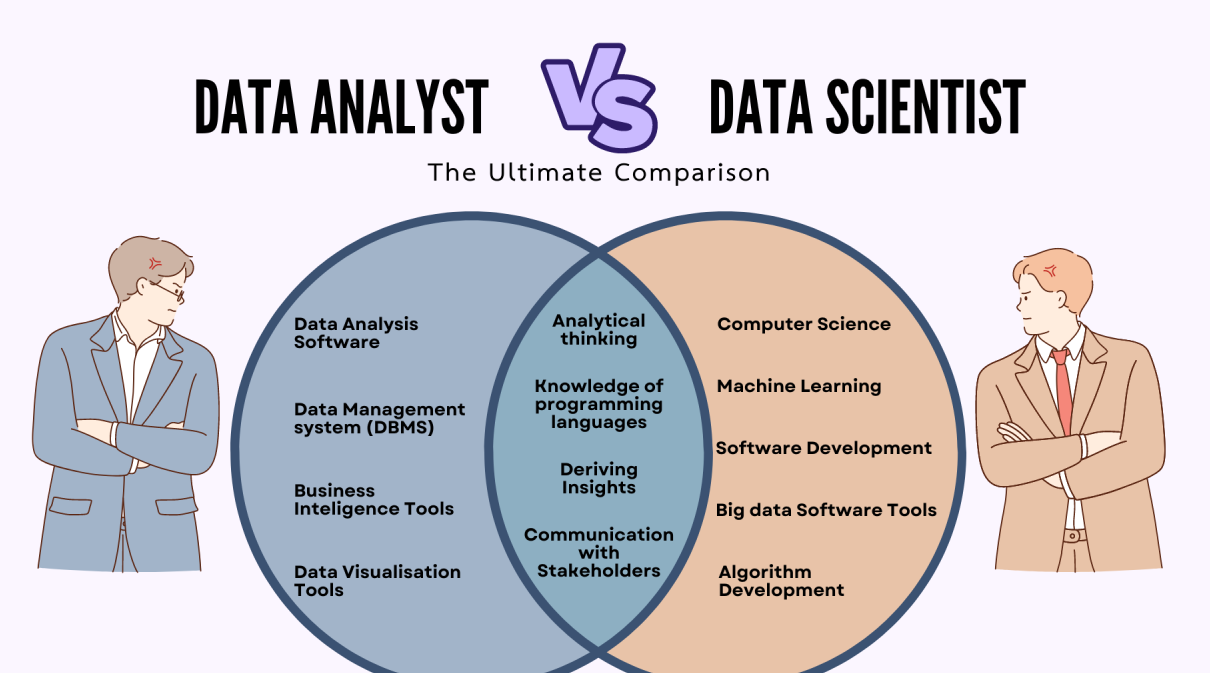
Key Differences Between Data Analytics and Data Science
Although the two fields overlap, several fundamental differences set them apart.
1. Scope
- Data Analytics focuses on analyzing existing data to solve specific problems.
- Data Science covers the entire data lifecycle, from data collection to model deployment.
2. Complexity
- Data Analytics is generally less complex and more focused on business intelligence.
- Data Science involves complex algorithms, machine learning, and automation.
3. Goal
- Data Analytics aims to interpret data and provide actionable insights.
- Data Science aims to build predictive and prescriptive models.
4. Skill Set
- Data Analysts rely more on statistics and visualization tools.
- Data Scientists require programming, machine learning, and advanced math skills.
5. Output
- Data Analytics produces reports, dashboards, and visualizations.
- Data Science produces predictive models and intelligent systems.
6. Data Handling
- Data Analysts mostly work with structured data.
- Data Scientists handle both structured and unstructured data (text, images, etc.).
Similarities Between Data Analytics and Data Science
Despite their differences, Data Analytics and Data Science share several similarities:
- Both rely heavily on data
- Both require statistical knowledge
- Both aim to support decision-making
- Both use programming tools like Python
- Both are in high demand across industries
When Should You Use Data Analytics?
Data Analytics is ideal when:
- You need quick insights from historical data
- You want to track performance metrics
- You need dashboards and reports
- Your business decisions are based on past trends
Example Use Cases
- Sales performance tracking
- Customer behavior analysis
- Marketing campaign evaluation
- Financial reporting
When Should You Use Data Science?
Data Science is more suitable when:
- You need predictive or automated solutions
- You are dealing with large and complex datasets
- You want to build intelligent systems
- Your goal is innovation and scalability
Example Use Cases
- Recommendation systems (like Netflix or Amazon)
- Fraud detection systems
- Chatbots and AI assistants
- Image and speech recognition
Career Comparison: Data Analyst vs Data Scientist
Data Analyst
Responsibilities:
- Analyze datasets
- Create dashboards
- Generate reports
- Communicate insights
Average Skill Level:
Beginner to Intermediate
Salary Range:
Moderate (varies by region)
Data Scientist
Responsibilities:
- Build machine learning models
- Process large datasets
- Develop algorithms
- Deploy data-driven solutions
Average Skill Level:
Intermediate to Advanced
Salary Range:
Higher than Data Analysts
Which Career Path Should You Choose?
Choosing between Data Analytics and Data Science depends on your interests, skills, and career goals.
Choose Data Analytics if:
- You enjoy working with data visualization
- You prefer business-focused roles
- You want a quicker entry into the tech field
- You have basic programming knowledge
Choose Data Science if:
- You enjoy coding and algorithms
- You are interested in AI and machine learning
- You have a strong math/statistics background
- You want to build advanced systems
The Future of Data Analytics and Data Science
Both fields are rapidly evolving, driven by advancements in technology such as artificial intelligence, big data, and cloud computing.
Trends in Data Analytics
- Self-service analytics tools
- Real-time dashboards
- Data democratization
Trends in Data Science
- AutoML (Automated Machine Learning)
- AI integration across industries
- Increased use of deep learning
- Ethical AI and data governance
As organizations continue to rely on data-driven decision-making, the demand for both Data Analysts and Data Scientists is expected to grow significantly.
Can Data Analytics Lead to Data Science?
Yes, many professionals start their careers in Data Analytics and transition into Data Science over time.
Steps to Transition:
- Learn advanced programming (Python/R)
- Study machine learning concepts
- Work on real-world projects
- Build a portfolio
- Gain experience with big data tools
This pathway is common because Data Analytics provides a strong foundation in working with data.
Common Misconceptions
1. They Are the Same
Many people assume Data Analytics and Data Science are identical. While related, they serve different purposes.
2. Data Science Is Always Better
Data Science is more advanced, but not always necessary. Many businesses benefit more from Data Analytics.
3. You Need a PhD for Data Science
While helpful, a PhD is not required. Practical skills and experience matter more.
Conclusion
Understanding the difference between Data Analytics and Data Science is essential for anyone looking to work with data or make data-driven decisions.
- Data Analytics focuses on analyzing past data to generate insights.
- Data Science goes further by building predictive models and intelligent systems.
Both fields are valuable, in-demand, and offer exciting career opportunities. The choice between them ultimately depends on your goals, interests, and the level of complexity you want to engage with.
Whether you choose to become a Data Analyst or a Data Scientist, one thing is clear: data is the future, and those who can harness its power will be at the forefront of innovation.
FAQs
Is Data Science harder than Data Analytics?
Yes, Data Science is generally more complex due to its reliance on machine learning and advanced mathematics.
Can I switch from Data Analytics to Data Science?
Absolutely. Many professionals transition by learning additional skills like programming and machine learning.
Which is more in demand?
Both roles are in high demand, but Data Science roles tend to be fewer and more specialized.
Do I need coding for Data Analytics?
Basic coding (especially SQL and Python) is often required, but not as extensively as in Data Science.