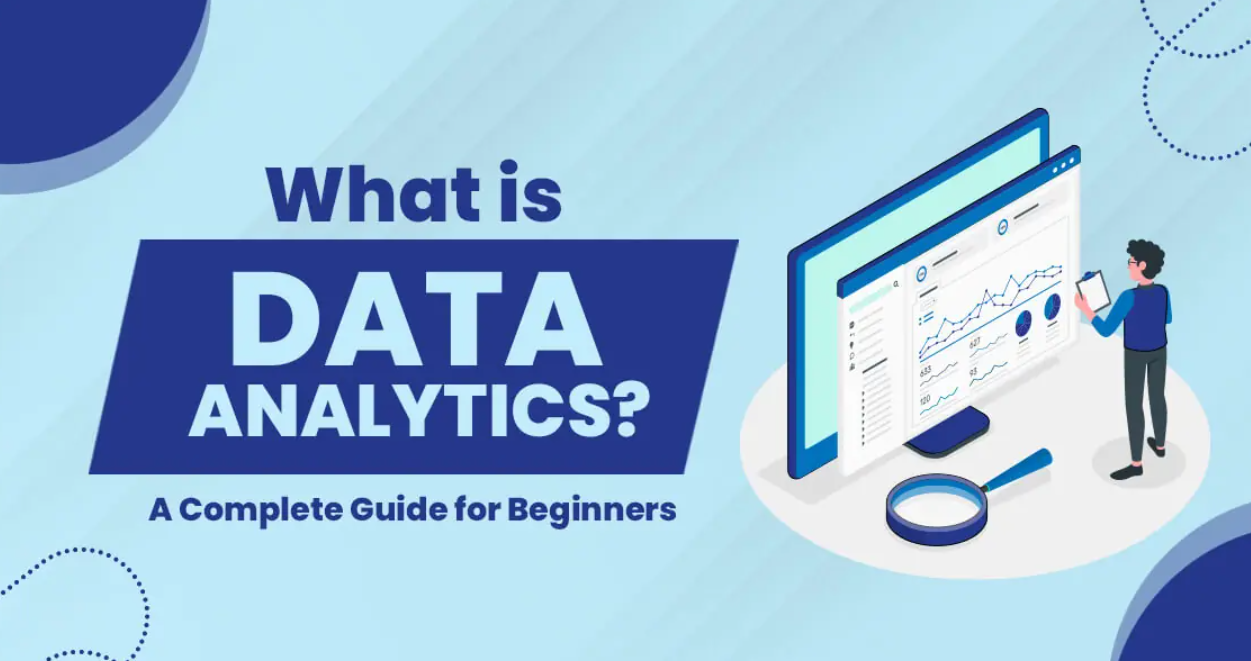
In today’s rapidly evolving digital world, data is everywhere. Every click, purchase, interaction, and movement generates information. But raw data alone is meaningless unless it is transformed into insights. This is where data analytics comes in. If you’re new to the concept, this comprehensive beginner’s guide will walk you through everything you need to know about data analytics in 2026—what it is, why it matters, types, tools, processes, and how to get started.
What Is Data Analytics?
Data analytics is the process of examining, cleaning, transforming, and interpreting data to discover useful information, identify patterns, and support decision-making. It combines statistics, computer science, and domain knowledge to extract meaningful insights from raw data.
In simple terms, data analytics helps answer questions like:
- What happened?
- Why did it happen?
- What will happen next?
- What should we do about it?
As businesses and organizations rely more on data-driven decisions, data analytics has become one of the most in-demand skills globally.
Why Data Analytics Matters in 2026
The importance of data analytics has grown significantly over the years, and in 2026, it is more critical than ever. Here are some key reasons why:
1. Data Explosion
With the rise of IoT devices, social media, cloud computing, and digital platforms, the amount of data generated daily is enormous. Organizations need analytics to make sense of this data.
2. Better Decision-Making
Data analytics allows companies to make informed decisions based on facts rather than intuition, reducing risks and improving outcomes.
3. Competitive Advantage
Businesses that leverage data effectively can identify trends faster, understand customer behavior, and stay ahead of competitors.
4. Personalization
From Netflix recommendations to targeted ads, data analytics enables personalized experiences for users.
5. Automation and AI Integration
Modern analytics is deeply integrated with artificial intelligence and machine learning, enabling predictive and automated insights.
Types of Data Analytics
Understanding the different types of data analytics is essential for beginners. There are four main categories:
1. Descriptive Analytics
Descriptive analytics answers the question: “What happened?”
It involves summarizing historical data using dashboards, reports, and visualizations. Examples include:
- Monthly sales reports
- Website traffic summaries
- Financial statements
2. Diagnostic Analytics
Diagnostic analytics focuses on: “Why did it happen?”
It digs deeper into data to find causes and correlations using techniques like:
- Drill-down analysis
- Data discovery
- Correlation analysis
3. Predictive Analytics
Predictive analytics answers: “What is likely to happen?”
It uses statistical models and machine learning algorithms to forecast future outcomes. Examples include:
- Sales forecasting
- Risk assessment
- Customer churn prediction
4. Prescriptive Analytics
Prescriptive analytics answers: “What should we do?”
It provides recommendations based on predictive insights. This is the most advanced form of analytics and often involves AI.
The Data Analytics Process
To understand how data analytics works, it’s helpful to break it down into a structured process:
Step 1: Data Collection
Data is gathered from various sources such as:
- Databases
- APIs
- Sensors
- Websites
- Surveys
Step 2: Data Cleaning
Raw data is often messy and incomplete. Cleaning involves:
- Removing duplicates
- Handling missing values
- Correcting errors
Step 3: Data Transformation
Data is converted into a suitable format for analysis. This may include:
- Normalization
- Aggregation
- Structuring data
Step 4: Data Analysis
Analysts apply statistical methods and algorithms to extract insights.
Step 5: Data Visualization
Insights are presented using charts, graphs, and dashboards for easy understanding.
Step 6: Decision-Making
Stakeholders use insights to make informed decisions.
Key Data Analytics Techniques
Several techniques are used in data analytics, depending on the goal:
1. Statistical Analysis
Uses mathematical models to understand relationships and trends.
2. Data Mining
Identifies patterns and relationships in large datasets.
3. Machine Learning
Allows systems to learn from data and improve predictions over time.
4. Text Analytics
Extracts insights from unstructured text data such as emails and social media.
5. Big Data Analytics
Handles extremely large datasets using distributed computing systems.
Popular Data Analytics Tools in 2026
To work effectively in data analytics, you need the right tools. Here are some of the most widely used:
1. Excel
Still widely used for basic analysis, especially for beginners.
2. SQL
Essential for querying databases and managing structured data.
3. Python
A powerful programming language with libraries like:
- Pandas
- NumPy
- Matplotlib
- Scikit-learn
4. R
Popular for statistical analysis and data visualization.
5. Power BI
A business intelligence tool for creating dashboards and reports.
6. Tableau
Known for its advanced visualization capabilities.
7. Apache Spark
Used for big data processing and analytics.
Data Analytics vs Data Science
Many beginners confuse data analytics with data science. While they are related, they are not the same.
| Aspect | Data Analytics | Data Science |
|---|---|---|
| Focus | Analyzing past data | Predicting future outcomes |
| Tools | Excel, SQL, BI tools | Python, R, ML frameworks |
| Complexity | Moderate | Advanced |
| Goal | Insights and reporting | Modeling and automation |
Data analytics is often considered a subset of data science.
Real-World Applications of Data Analytics
Data analytics is used across industries. Here are some examples:
1. Healthcare
- Predicting disease outbreaks
- Improving patient care
- Optimizing hospital operations
2. Finance
- Fraud detection
- Risk management
- Investment analysis
3. Retail
- Customer segmentation
- Inventory management
- Pricing strategies
4. Marketing
- Campaign performance analysis
- Customer behavior tracking
- Conversion optimization
5. Transportation
- Route optimization
- Demand forecasting
- Autonomous vehicle systems
Skills Required for Data Analytics
To become a successful data analyst in 2026, you need a mix of technical and soft skills:
Technical Skills
- Data cleaning and preparation
- Statistical analysis
- Programming (Python or R)
- SQL and databases
- Data visualization
Soft Skills
- Critical thinking
- Problem-solving
- Communication
- Attention to detail
Challenges in Data Analytics
Despite its benefits, data analytics comes with challenges:
1. Data Quality Issues
Poor-quality data can lead to incorrect conclusions.
2. Data Privacy and Security
Handling sensitive data requires strict compliance with regulations.
3. Skill Gap
There is a high demand for skilled professionals, but not enough supply.
4. Complexity of Tools
Some analytics tools have a steep learning curve.
Trends in Data Analytics for 2026
The field of data analytics continues to evolve. Here are some key trends:
1. Augmented Analytics
AI-powered tools that automate data preparation and insight generation.
2. Real-Time Analytics
Organizations are increasingly relying on real-time data for instant decisions.
3. Edge Analytics
Processing data closer to its source, especially in IoT applications.
4. Data Democratization
Making data accessible to non-technical users through user-friendly tools.
5. Ethical AI and Data Governance
Greater focus on transparency, fairness, and data ethics.
How to Get Started with Data Analytics
If you’re a beginner, here’s a step-by-step roadmap:
Step 1: Learn the Basics
Start with understanding:
- What data is
- Types of data
- Basic statistics
Step 2: Master Excel and SQL
These are foundational tools for data analysis.
Step 3: Learn a Programming Language
Python is highly recommended for beginners.
Step 4: Practice with Real Data
Work on datasets from platforms like Kaggle.
Step 5: Build a Portfolio
Showcase your projects to demonstrate your skills.
Step 6: Take Online Courses
Enroll in structured learning programs to deepen your knowledge.
Career Opportunities in Data Analytics
Data analytics offers a wide range of career paths:
- Data Analyst
- Business Analyst
- Data Engineer
- Analytics Consultant
- Business Intelligence Analyst
Salary Outlook
In 2026, data analytics professionals continue to enjoy competitive salaries due to high demand across industries.
The Future of Data Analytics
The future of data analytics is incredibly promising. With advancements in AI, automation, and computing power, analytics will become even more powerful and accessible.
Key future developments include:
- Fully automated analytics systems
- Integration with augmented reality
- Increased use of natural language queries
- Enhanced predictive and prescriptive capabilities
Organizations that embrace data analytics will continue to thrive in the digital economy.
Conclusion
Data analytics is no longer optional—it is essential. Whether you are a student, professional, or business owner, understanding data analytics can open doors to new opportunities and smarter decision-making.
In this beginner’s guide for 2026, we explored:
- What data analytics is
- Why it matters
- Types and processes
- Tools and techniques
- Career opportunities and future trends
As the world becomes increasingly data-driven, now is the perfect time to start your journey into data analytics. With the right skills, tools, and mindset, you can turn data into powerful insights and make a meaningful impact in any industry.